THE RECOVERY REPORT
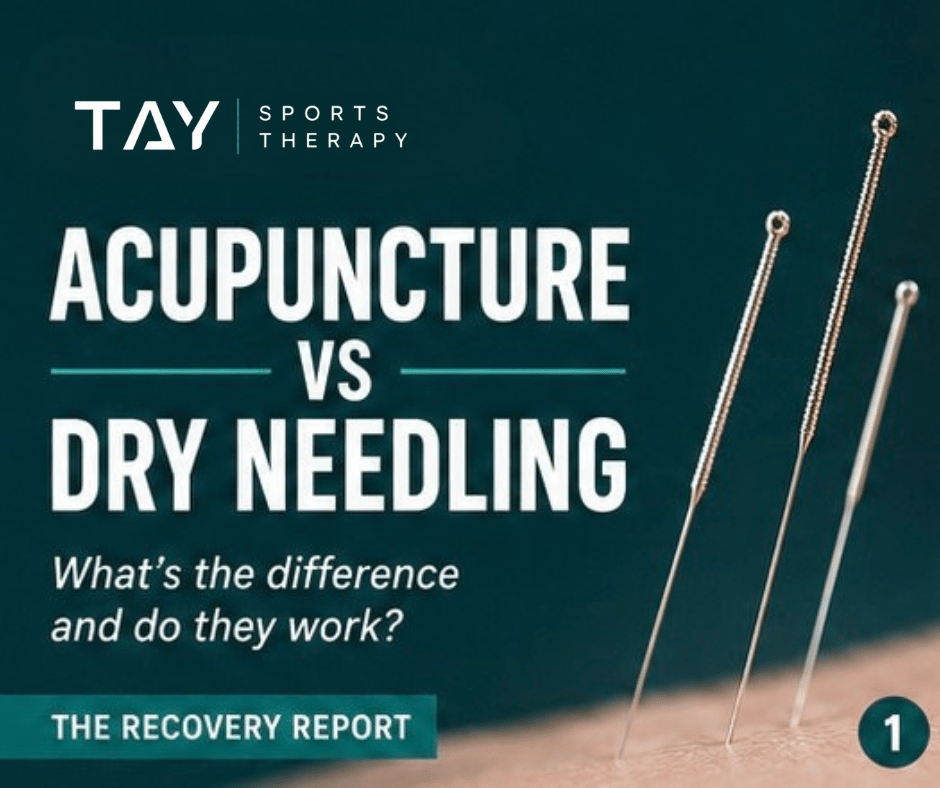
If you’ve ever had treatment with needles, you’ve probably heard the terms acupuncture and dry needling used interchangeably.
They look similar.
They use similar needles.
But they’re not exactly the same thing.
Understanding the difference can help you make informed decisions about your treatment and understand what your therapist is trying to achieve.
WHAT IS DRY NEEDLING?
Dry needling is a technique used by healthcare professionals to target painful or dysfunctional muscles.
A thin needle is inserted into a muscle, often into a sensitive area known as a trigger point. The aim is to reduce muscle tension, improve movement and help settle pain.
Dry needling is based on modern anatomy, neuroscience and pain science. It focuses on muscles, connective tissue and the nervous system rather than traditional acupuncture theories.
WHAT IS ACUPUNCTURE?
Traditional acupuncture originates from Chinese medicine and involves placing needles at specific points throughout the body.
Medical acupuncture, commonly used by sports therapists and other healthcare professionals, combines traditional acupuncture points with modern clinical reasoning and current understanding of pain mechanisms.
In practice, many clinicians use elements of both approaches depending on the individual and their symptoms.
DO THEY WORK?
Research suggests that both acupuncture and dry needling can provide short-term pain relief for some musculoskeletal conditions. However, neither should be viewed as a magic fix.
The greatest benefit often comes when needling is used alongside exercise, rehabilitation, education and load management rather than as a standalone treatment.
HOW DO NEEDLES HELP?
The exact mechanisms are still being investigated, but proposed effects include:
- Reducing muscle sensitivity
- Influencing pain signalling within the nervous system
- Improving local blood flow
- Creating temporary pain modulation that allows movement and exercise to become easier
Importantly, needles are not “breaking down scar tissue” or “releasing toxins” as is sometimes claimed.
ARE THERE RISKS?
Most people experience little more than temporary soreness, bruising or a dull ache after treatment.
Like any invasive treatment, there are risks. Serious complications are rare but can occur if needling is performed incorrectly. This is why training, anatomical knowledge and safe practice standards are essential.
WHEN MIGHT I USE NEEDLING?
Needling may be considered when:
- Muscle pain is limiting movement
- Symptoms are preventing progression with rehabilitation
- Temporary pain relief would help restore normal movement
- A patient prefers it as part of their treatment plan
It is rarely the only thing needed.
The goal is usually to create a window of opportunity for movement, exercise and rehabilitation.
RECOVERY PRINCIPLE
Acupuncture and dry needling are tools, not cures.
The needle itself isn’t what creates long-term change. Long-term improvement comes from combining appropriate treatment with movement, strength, recovery and addressing the factors that contributed to the problem in the first place.
A needle may help open the door, but rehabilitation is what keeps it open.
Expert Care For Your Recovery, Performance And Wellbeing


Leave a Reply