
THE RECOVERY REPORT

You may have come across the “5 pillars of sports therapy.”
They are commonly used to describe the role of a sports therapist, particularly in education and professional standards.
At a surface level, they are logical and cover the journey from injury through to recovery.
The more important question is whether they reflect modern, evidence-informed clinical practice.
What are the 5 pillars?
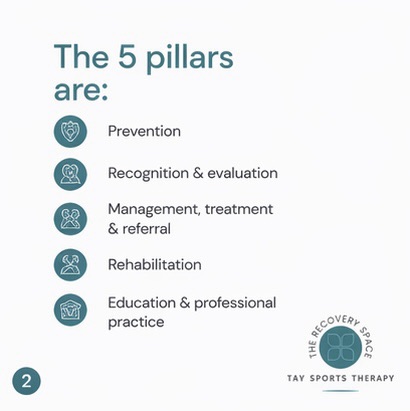
They are typically described as:
- Prevention
- Recognition and evaluation
- Management, treatment and referral
- Rehabilitation
- Education and professional practice
They outline the broad scope of what a sports therapist does.
Where they remain useful
As a framework, the pillars still have value.
They reflect the key components of good care:
- Appropriate assessment
- Informed management decisions
- Structured rehabilitation
- Ongoing education and support
They provide a foundation for practice, but they do not represent how care is delivered in reality.
Where they fall short
The limitation is not what they include, but what they do not address.
Modern pain science has moved on
Our understanding of pain has changed significantly.
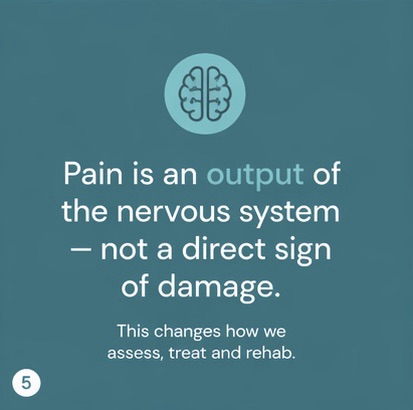
Pain is not a direct measure of tissue damage. It is an output of the nervous system, influenced by multiple factors.

These include:
- Tissue health and physical load
- Stress and emotional state
- Sleep and recovery
- Previous injury experiences
- Beliefs and expectations around pain
This means:
- You can have significant pain with minimal tissue damage
- You can also have tissue changes with little or no pain
The 5 pillar model does not explicitly account for this.
It leans towards a more traditional, tissue-focused view, which can oversimplify how pain presents and how recovery should be approached.
They do not reflect clinical reasoning
The pillars describe areas of practice, but they do not guide how decisions are made.
Modern care relies on:
- Continuous assessment and re-assessment
- Interpreting response to load
- Managing uncertainty
- Adjusting the plan based on the individual
This is where clinical skill sits.
Rehabilitation has evolved
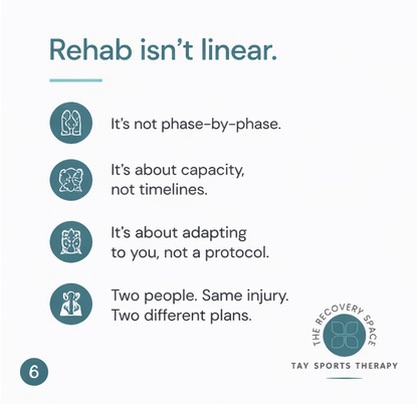
Rehabilitation is no longer best understood as a fixed, phase-based process.
It is centred around:
- Gradual and appropriate loading
- Building physical capacity
- Restoring confidence in movement
- Individual progression
Two people with the same presentation may require very different approaches.
Treatment is often misunderstood
There can be an expectation that treatment is about identifying a problem and fixing it.
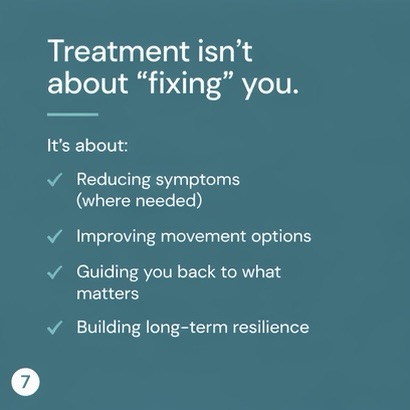
In practice, it is more accurately about:
- Reducing symptoms where appropriate
- Improving movement options
- Supporting a return to activity
- Promoting long-term self-management
This reflects a shift away from passive care towards active, sustainable outcomes.
What modern practice looks like
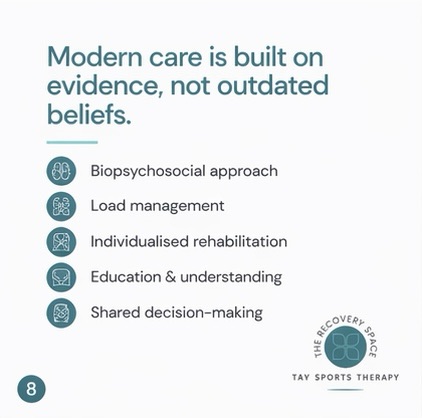
Evidence-informed musculoskeletal care is now built around:
- A biopsychosocial approach
- Integration of modern pain science
- Individualised rehabilitation
- Load management principles
- Clear education and communication
- Shared decision-making
These elements are central to achieving long-term results.
So, are the 5 pillars outdated?
They remain relevant as a broad description of the profession.
However, they are not a complete or up-to-date model of clinical practice.
They are best viewed as a foundation, not a framework for how care should be delivered.
What this means for you
Effective rehabilitation should not feel generic or overly prescriptive.
It should be:
- Individualised
- Adaptable
- Clearly explained
- Aligned with your goals and lifestyle
This is what supports meaningful, long-term progress.
Recovery Principle
Pain is not simply a sign of damage. It is influenced by the whole system. Good rehabilitation reflects that.

If you would like support with an injury, ongoing pain, or returning to training, you can book an appointment here:
Visit www.taysportstherapy.co.uk for more tips from The Recovery Report.
Expert Care For Your Recovery, Performance And Wellbeing


Leave a Reply