THE RECOVERY REPORT
There’s often confusion about roles in musculoskeletal care.
If someone works with injuries, shouldn’t they diagnose them?
Not necessarily — and that clarity improves care.
Diagnosis vs Rehabilitation
A medical diagnosis answers:
- What is the pathology?
- Is imaging required?
- Is medication or surgery needed?
- Are there red flags present?
That responsibility sits with medical and regulated diagnostic professionals.
Sports therapy focuses on something different:
- How is this person functioning?
- What can they currently tolerate?
- What has changed in their training or activity?
- How do we safely rebuild capacity?
Both roles matter — they simply serve different purposes.
Why a Label Isn’t Always the Solution
In many common musculoskeletal conditions, early management looks very similar regardless of the name given.
Evidence consistently supports:
- Load modification
- Progressive strengthening
- Education
- Gradual return to activity
Tendon rehabilitation responds well to structured loading (Malliaras et al., 2013). Patellofemoral pain improves with strength-based interventions (Crossley et al., 2016). Rapid training load increases are strongly linked to injury risk (Gabbett, 2016).
In many cases, recovery is driven by how load is managed — not by the diagnostic label.
What Sports Therapy Focuses On
When someone presents with pain, the key questions are:
- What is aggravating symptoms?
- Where has capacity reduced?
- What is the appropriate starting point?
- How should load progress over time?
Assessment may include:
- Movement analysis
- Strength testing
- Load history
- Lifestyle and recovery factors
The aim is a structured, individualised plan — whether someone is preparing for an event, returning to training, or simply wanting to move without discomfort.
When You Should Seek Medical Diagnosis
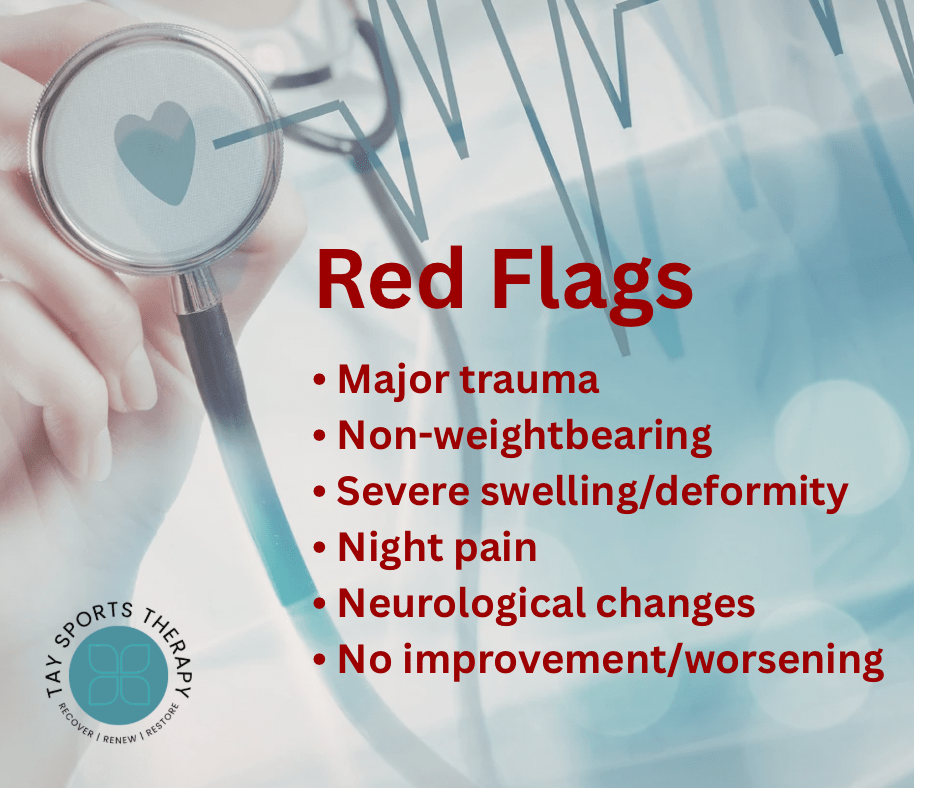
Medical assessment is important if you experience:
- Significant trauma
- Inability to weight bear
- Severe swelling or visible deformity
- Night pain unrelated to movement
- Unexplained systemic symptoms
- Neurological changes (numbness, weakness, bladder/bowel issues)
- Pain that worsens or does not improve despite appropriate management
Screening for these signs is part of responsible practice.
Referral, when needed, is good care — not a failure of it.
Contact Us:
Diagnosis identifies pathology.
Rehabilitation restores function.
Sports therapy focuses on:
Managing load Building capacity Improving resilience Supporting return to meaningful activity
Not diagnosing isn’t a limitation.
It’s clarity of role — and clarity improves outcomes.
Visit www.taysportstherapy.co.uk, select the Book Now button below or follow @taysportstherapy for more tips from The Recovery Report.
References
Crossley, K.M., van Middelkoop, M., Callaghan, M.J., Collins, N.J., Rathleff, M.S. and Barton, C.J. (2016) ‘Patellofemoral pain consensus statement from the 4th International Patellofemoral Pain Research Retreat’, British Journal of Sports Medicine, 50(14), pp. 842–850.
Gabbett, T.J. (2016) ‘The training–injury prevention paradox: should athletes be training smarter and harder?’, British Journal of Sports Medicine, 50(5), pp. 273–280.
Kjaer, M., Langberg, H., Heinemeier, K., Bayer, M.L., Hansen, M., Holm, L., Doessing, S. and Magnusson, S.P. (2009) ‘From mechanical loading to collagen synthesis, structural changes and function in human tendon’, Scandinavian Journal of Medicine & Science in Sports, 19(4), pp. 500–510.
Malliaras, P., Barton, C.J., Reeves, N.D. and Langberg, H. (2013) ‘Achilles and patellar tendinopathy loading programmes: a systematic review comparing clinical outcomes and identifying potential mechanisms for effectiveness’, Sports Medicine, 43(4), pp. 267–286.
National Institute for Health and Care Excellence (NICE) (2020) Low back pain and sciatica in over 16s: assessment and management (NG59). London: NICE. Available at: https://www.nice.org.uk/guidance/ng59 (Accessed: 1 February 2026).
O’Sullivan, P., Caneiro, J.P., O’Keeffe, M. and O’Sullivan, K. (2018) ‘Unraveling the complexity of low back pain’, Journal of Orthopaedic & Sports Physical Therapy, 48(11), pp. 932–937.
Expert Care For Your Recovery, Performance And Wellbeing


Leave a comment